
How Modern Product Marketing Agencies Improve Cross-Functional Collaboration
Product launches rarely struggle because one team is not working hard enough. More often, product, marketing, sales, creative, and leadership are working from different information, toward different priorities, or on different timelines.
Messaging changes between teams. Decisions happen too late. Ownership is unclear. Sales receives enablement materials days before launch—or cannot find them afterward.
A modern product marketing agency should do more than produce launch assets. It should strengthen the marketing workflows, shared systems, and cross-functional collaboration required to move a product from strategy to market.
Why Communication Breakdowns Disrupt Launches
Every launch has cross-functional dependencies. Product understands what is being built. Product marketing determines how it should be positioned. Marketing brings that story to market. Sales translates it into customer conversations.
When those teams are disconnected, even a strong go-to-market strategy can break down during execution.
Common warning signs include:
Teams describing the product differently
Unclear decision and approval authority
Important feedback arriving too late
Repeated revisions to the same assets
Missing or outdated sales materials
Last-minute requests that delay the launch
More meetings will not necessarily solve these problems. Teams need shared direction, clearer ownership, and a GTM workflow that connects decisions to delivery.
Using the Beyond Limits Framework to Find Launch Friction
At Quantious, we developed the Beyond Limits Framework to help teams identify why their important work gets stuck. It looks at go-to-market performance across three connected areas: Process, Strategy, and Execution.
This matters because the most visible problem is not always the root cause.
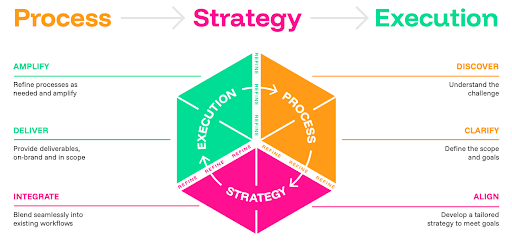
A delayed sales deck may look like an execution problem, but the actual issue could be unresolved positioning within the strategy. A missed launch deadline may appear to be a project-management failure, while unclear ownership within the process is really responsible.
By looking at all three areas, teams can find where cross-functional collaboration is breaking down and address the underlying issue.
Strategy: Align Teams Before Activation
Strong collaboration begins with shared direction.
Before activation starts, product, marketing, and sales should agree on:
The customer problem
The ideal customer profile
Product positioning
Buyer needs and signals
Competitive differentiation
Launch goals
Strategic choices and guardrails
Without this foundation, each team may make decisions based on a different understanding of the product. Those differences eventually appear as inconsistent messaging, disconnected campaigns, and repeated revisions.
A shared messaging framework makes the strategy usable. It establishes the core value proposition, key benefits, supporting proof points, approved claims, and audience-specific messages that should guide marketing campaigns, product communications, and sales conversations.
A product marketing agency can gather input from each team, resolve inconsistencies, and translate complex product information into a framework everyone can use.
Process: Create Clarity Before Execution
Once teams agree on the direction, they need a repeatable launch process for moving the work forward.
A launch playbook can establish:
Stakeholder roles and decision owners
Key milestones and deliverables
Required inputs
Review and approval timelines
Risks and dependencies
Communication checkpoints
Sales and marketing readiness criteria
The goal is not to add unnecessary processes, for process sake. It is to give everyone enough clarity to understand what is happening, what they own, and what needs to happen next.
This is also where documentation and internal knowledge management become essential. Messaging, product information, launch decisions, customer insights, and competitive intelligence should not be scattered across inboxes, meeting notes, and individual files.
Modern product marketing agencies can help teams create a reliable source of truth and build marketing workflows around how people actually work. That reduces time spent searching for information, recreating existing work, or acting on outdated decisions.
Execution: Orchestrate Work That Sticks
Execution is where strategy and process become something customers and internal teams can experience.
This may include:
Campaign and channel activation
Content and creative production
Product communications
Cross-functional handoffs
Quality assurance
Sales enablement
Performance measurement
Post-launch retrospectives
A product marketing agency can help orchestrate these moving pieces while maintaining consistency from initial positioning through final delivery.
It can also make enablement part of the launch, instead of a last-minute handoff. Sales teams need more than a finished battlecard or presentation. They need to understand what changed, why it matters, how to communicate it, and where to find the latest resources.
Sales can then provide feedback about buyer questions, competitive objections, and which messages are resonating. That feedback should inform future marketing execution and product marketing strategy.
Using AI to Strengthen the GTM Workflow
AI can support each part of the Beyond Limits Framework when it is applied to a clear workflow.
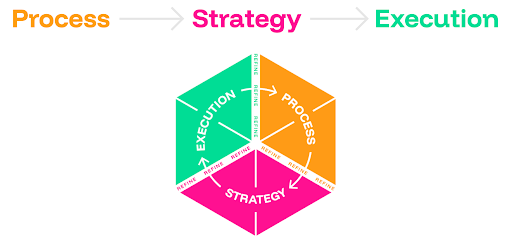
Within Strategy, AI can help synthesize research, organize market signals, and compare messaging themes.
Within Process, it can summarize meetings, organize stakeholder feedback, document decisions, and make internal knowledge easier to retrieve.
Within Execution, it can support early content drafts, adapt approved messaging for different audiences, and review materials for consistency.
But AI cannot compensate for missing strategy, unclear ownership, or unreliable information. Teams still need human judgment, documented guardrails, and accurate source material.
The right product marketing agency will help teams identify where AI adds value to their marketing operations, without adding disconnected tools or automating a broken process.
Better Collaboration Starts With the Root Cause
Cross-functional collaboration is not simply a matter of communicating more. Teams need shared direction, clear processes, accessible knowledge, and coordinated execution.
The Beyond Limits Framework helps organizations determine whether their GTM friction originates in Process, Strategy, or Execution. This allows them to address the root cause rather than repeatedly fixing downstream symptoms.
At Quantious, we work alongside B2B tech marketing teams to uncover these hidden roadblocks, strengthen marketing operations, and turn go-to-market priorities into finished projects.
Because better collaboration does more than keep a launch organized. It helps every team move in the same direction.
Where is your GTM workflow getting stuck? [Take the Beyond Limits Assessment.]